
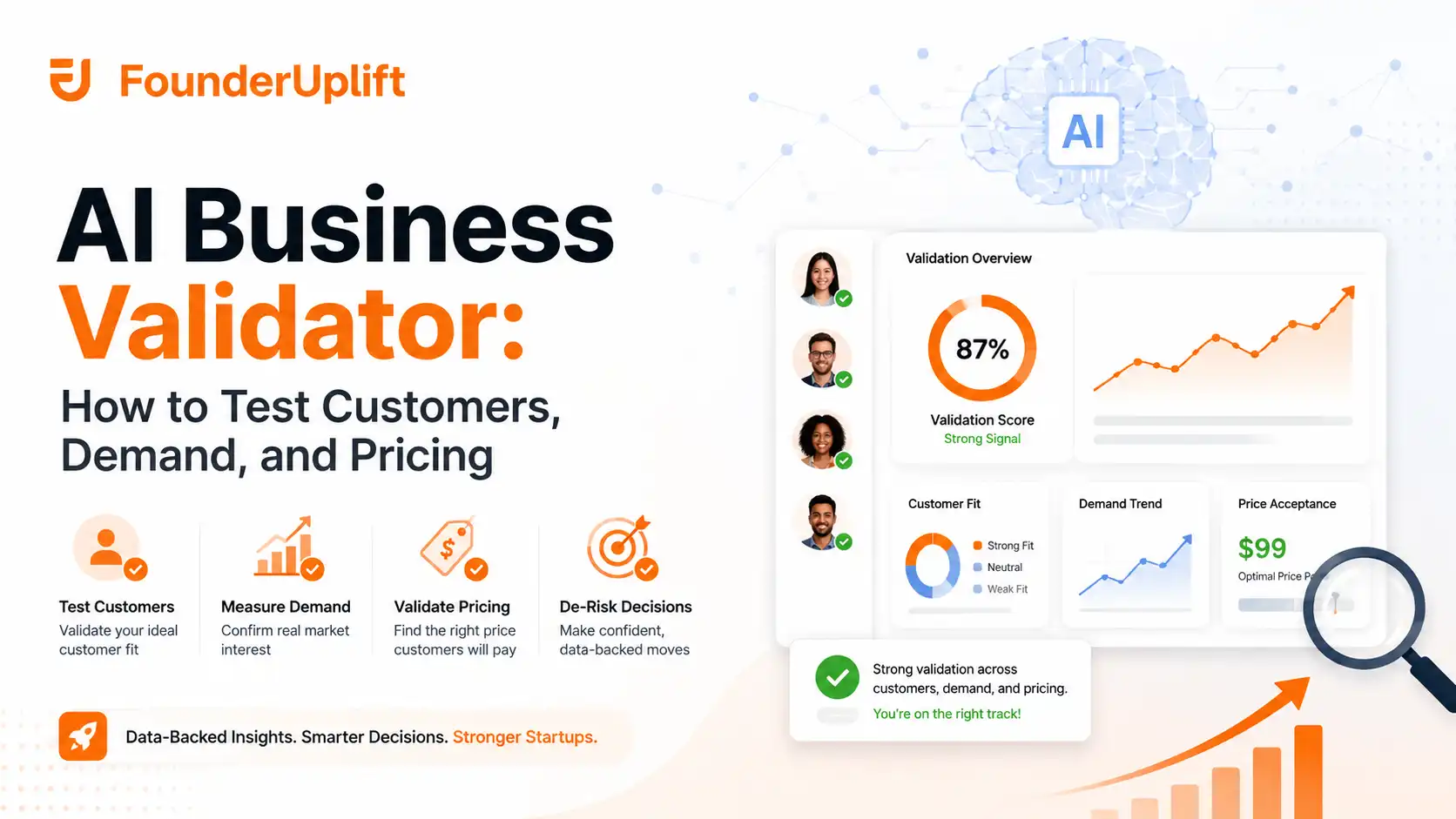
AI Business Validator: How to Test Customers, Demand, and Pricing
An AI Business Validator can help entrepreneurs turn a promising idea into a structured set of questions about customers, demand, competition, pricing, and market potential. However, AI should not be treated as a machine that can predict whether a startup will succeed. Its real value is helping founders research faster, organize evidence, identify assumptions, and design better validation tests.
That distinction matters.
A business idea may sound innovative, solve an interesting problem, or receive positive reactions from friends. Yet none of those signals prove that enough customers want the solution, can be reached profitably, or are willing to pay an appropriate price.
Effective business idea validation therefore requires evidence from the market.
That evidence may come from customer interviews, search behavior, competitor activity, pricing tests, landing-page conversions, paid pilots, pre-orders, purchases, retention, and referrals.
An AI business validator can make this process more efficient. For example, AI can help summarize customer interviews, organize competitor features, identify repeated pain points, cluster market research, generate hypotheses, and compare possible pricing models.
Nevertheless, real customers must remain at the center of the process.
This guide explains how to use AI-assisted business validation to test three critical areas: customers, market demand, and pricing. It also covers startup validation, market research, customer validation, competitor analysis, willingness to pay, MVP testing, customer acquisition, and product-market fit.
What Is an AI Business Validator?
An AI Business Validator is a process, tool, or AI-assisted framework used to evaluate whether a business concept has enough evidence to justify further investment.
It does not simply answer:
“Is this a good idea?”
A useful validator asks deeper questions:
Who is the customer?
What problem are they trying to solve?
How painful is that problem?
What alternatives already exist?
Are customers actively searching or paying for solutions?
How should the offer be positioned?
What price may be acceptable?
Can customers be acquired sustainably?
How an AI Business Validator Helps Founders
AI can quickly organize large amounts of information that would otherwise require significant manual research.
For example, it can help analyze:
customer interview notes;
competitor positioning;
market reviews;
repeated complaints;
pricing structures;
search-intent themes.
Turn Business Assumptions Into Testable Questions
A founder may begin with the assumption:
“Small businesses need better automated reporting.”
A better validation question would be:
“Which small businesses experience reporting problems frequently enough to pay for automation, and what are they currently using?”
Use Evidence Instead of Guesswork
That shift is essential because business validation should reduce uncertainty rather than reinforce founder enthusiasm.
AI Business Validator vs Traditional Business Validation
Traditional validation typically involves customer interviews, market research, competitor analysis, surveys, prototypes, and pricing tests.
AI does not replace these methods.
Instead, it can make them faster.
Faster Research and Pattern Analysis
For example, after conducting 20 customer interviews, you might use AI to categorize:
repeated problems;
buying objections;
current solutions;
desired outcomes;
language customers use.
However, AI-generated summaries still require human review.
Human Judgment Still Matters for Final Decisions
AI does not know your customer personally.
It may misunderstand context, overgeneralize small samples, or generate conclusions unsupported by the evidence.
Therefore, founders should treat AI as a decision-support tool.
What an AI Business Validator Should Actually Test
A useful validation framework should examine three core questions.
Customer Fit
Are you targeting the right people?
Market Demand
Is there enough evidence that people want the solution?
Pricing
Will customers pay enough to support a sustainable business model?
These three dimensions are connected. Strong demand among the wrong customer segment can still produce weak results. Similarly, enthusiastic customers may not support the business if the acceptable price is too low.
Why AI Business Validation Matters Before You Invest
The earlier you validate important assumptions, the cheaper it usually is to change direction.
Reduce Financial Risk Early
Suppose you plan to build a SaaS platform.
You could immediately hire developers, design dozens of features, and spend months building.
Alternatively, you could:
interview potential customers;
test a landing page;
provide the service manually;
ask for a paid pilot;
build only after customers show commitment.
The second approach provides learning before heavy investment.
Test Before Building a Full Product
Early validation may reveal that customers want a different feature, audience, price, or business model.
Small Experiments Can Prevent Expensive Mistakes
Changing a landing-page message is inexpensive.
Rebuilding an entire product is not.
Step 1: Define the Business Idea Clearly
Before using AI to validate anything, make the idea specific.
Describe the Problem You Want to Solve
A useful format is:
[Customer] experiences [problem] in [situation], causing [impact].
For example:
“Independent consulting firms struggle to organize client research across multiple tools, causing duplicated work and slower project delivery.”
Identify the Customer, Situation, and Pain
Avoid broad statements such as:
“Businesses need better productivity.”
That is too vague to validate.
Make the Problem Specific and Measurable
The clearer the problem, the easier it becomes to interview customers and evaluate demand.
Define the Proposed Solution
Explain what your solution does in plain language.
Instead of saying:
“AI-powered intelligent workflow ecosystem,”
say:
“A system that organizes customer research, summarizes documents, and creates client-ready reports.”
Explain the Core Customer Outcome
Customers care about outcomes such as:
saving time;
reducing costs;
generating revenue;
avoiding errors;
improving convenience.
Focus on Benefits Instead of Features
Technology is rarely the reason people buy.
The result is.
Step 2: Identify Your Riskiest Business Assumptions
Every startup contains assumptions.
The goal is to find the ones that could destroy the business if they are wrong.
Customer Assumptions
Who do you believe will buy?
“Entrepreneurs” is broad.
“Independent digital marketing agencies with 5–20 employees” is testable.
Problem Assumptions
How painful is the issue?
Measure:
frequency;
severity;
urgency;
cost.
Demand Assumptions
Why would customers change their current behavior?
Look for evidence that they already search, complain, compare, or spend money.
Pricing Assumptions
What do you believe customers will pay?
Do not rely entirely on hypothetical surveys.
Acquisition Assumptions
How will you reach customers?
A good product still needs a workable distribution strategy.
Step 3: Use AI to Build a Clear Ideal Customer Profile
AI can help organize customer characteristics, but it should not invent your market.
Define Customer Characteristics
For B2C businesses, examine:
age;
location;
income;
lifestyle;
goals;
buying behavior.
For B2B businesses, examine:
industry;
company size;
role;
purchasing authority;
existing tools;
budget.
Identify Customer Motivations
Ask what makes the buyer act.
Common motivations include:
saving money;
making money;
saving time;
avoiding risk;
simplifying work;
improving status;
reducing frustration.
Identify Early Adopters
Early adopters often feel the problem more strongly than the broader market.
They may already be searching for alternatives.
Avoid AI-Generated Personas Without Real Evidence
AI can create realistic-looking personas in seconds.
However, a detailed fictional persona is still fictional.
Treat Personas as Hypotheses
Use AI to suggest questions.
Then verify those assumptions with actual customers.
Step 4: Validate the Customer Problem
Problem validation should come before complex product development.
Write a Clear Problem Statement
Describe:
who;
what;
when;
impact.
Measure Problem Frequency
Ask customers:
“How often did this happen during the last month?”
Specific questions produce better evidence than asking whether a problem is “important.”
Measure Problem Severity
Investigate the cost.
The impact might include:
lost sales;
wasted labor;
delayed work;
customer complaints;
operational risk.
Analyze the Cost of Doing Nothing
This is particularly valuable.
Ask:
“What happens if you continue using the current process?”
If the answer is “almost nothing,” customers may not pay.
If the answer involves serious financial or operational consequences, willingness to pay may be stronger.
Step 5: Conduct Customer Interviews With AI Support
Customer interviews remain one of the strongest startup validation methods.
Choose the Right Interview Participants
Talk to people who could genuinely buy.
Ten qualified prospects can provide more useful evidence than hundreds of random survey respondents.
Ask About Past Behavior
Useful questions include:
When did this problem last happen?
What did you do?
How long did it take?
What did it cost?
What did you dislike?
What have you already tried?
Past Actions Are More Reliable Than Future Intentions
Avoid depending on:
“Would you buy my idea?”
People often want to be supportive.
Instead, study what they have already done.
Ask About Existing Solutions
Customers may currently use:
software;
employees;
consultants;
spreadsheets;
manual processes.
Current Solutions Reveal Your True Competition
Your biggest competitor may not be another startup.
It may be customer inertia.
Use AI to Analyze Interview Notes
After interviews, AI can help organize patterns.
For example, you can categorize statements by:
pain point;
current workaround;
spending;
objections;
desired result.
Manually Review Important Themes Before Acting
Do not accept every AI conclusion automatically.
Re-read important customer statements to confirm the interpretation.
Step 6: Use an AI Business Validator to Research Market Demand
Customer interviews reveal depth.
Market research helps determine scale.
Analyze Search Demand
Search behavior can indicate whether customers are actively researching the problem.
Problem-Aware Keywords
These reveal customer pain.
Examples include:
“how to automate invoice processing”
or
“reduce customer support workload.”
Solution-Aware Keywords
These indicate customers already understand possible solutions.
Commercial Keywords
Words such as:
pricing;
best;
review;
comparison;
alternative;
often suggest stronger commercial intent.
Commercial Search Intent Can Reveal Stronger Demand
A buyer searching for “best payroll software for small businesses” is likely closer to a purchase decision than someone searching “what is payroll software?”
Study Market Trends
Demand can be:
growing;
stable;
seasonal;
declining.
Separate Sustainable Demand From Temporary Hype
This is particularly important with AI-related businesses.
A trending technology can create attention without creating sustainable buying behavior.
Analyze Customer Discussions
Look at reviews, industry communities, forums, and public discussions.
Repeated complaints can indicate unmet needs.
However, do not assume every complaint represents a profitable opportunity.
Customers must care enough to pay for change.
Estimate Market Size
Use three levels.
TAM: Total Addressable Market
The broadest potential market.
SAM: Serviceable Available Market
The portion your business can realistically serve.
SOM: Serviceable Obtainable Market
The segment you may realistically capture.
Focus on the Market You Can Realistically Win
A huge market does not guarantee a successful startup.
A narrow niche with strong pain and reachable customers can be more attractive.
Step 7: Analyze Competitors With AI
Competitor research helps validate market expectations.
Identify Direct Competitors
Compare:
customers;
features;
pricing;
positioning;
reviews;
business models.
Identify Indirect Competitors
Customers may solve the same problem differently.
For example, software may compete with:
spreadsheets;
freelancers;
agencies;
internal staff.
Analyze Competitor Reviews
Look for repeated complaints.
Common themes might include:
difficult onboarding;
weak support;
expensive plans;
missing integrations;
complex interfaces.
Identify What Competitors Do Well
Positive reviews matter too.
They reveal what customers consider essential.
Use AI to Build a Competitor Comparison
AI can organize competitor information into categories and identify patterns.
However, always verify important claims directly from current competitor sources.
Competitor pricing, features, and positioning can change.
Step 8: Score Your Business Idea With an AI Business Validator
Scoring can help organize thinking, but it should never be treated as proof.
Score Problem Strength
Evaluate:
severity;
frequency;
urgency.
Score Customer Clarity
How clearly defined is the buyer?
Score Market Demand
Combine evidence from:
searches;
spending;
competitors;
conversations;
customer actions.
Score Differentiation
Why should customers choose you?
Being different is not enough.
The difference needs to matter.
Score Willingness to Pay
Existing customer spending deserves more weight than hypothetical interest.
Score Customer Acquisition Potential
Can you realistically reach buyers?
A strong idea with extremely expensive acquisition may produce poor economics.
Step 9: Validate Your Value Proposition
Your value proposition should explain the result customers receive.
Define the Customer Outcome
Potential outcomes include:
saving time;
reducing costs;
increasing revenue;
improving quality;
reducing frustration.
Write a Clear Value Proposition
A useful formula is:
We help [customer] achieve [outcome] through [solution] without [major frustration].
For example:
“We help independent agencies create client research reports faster without manually organizing information across multiple tools.”
Step 10: Test Market Demand With a Landing Page
A landing page allows you to test messaging before a full launch.
Build a Simple Validation Landing Page
Include:
problem;
solution;
benefits;
evidence;
CTA.
Choose a Strong Validation CTA
Possible actions include:
Join a Waitlist
Useful for measuring early interest.
Request a Demo
Useful for B2B products.
Start a Trial
Useful for testing actual engagement.
Pre-Order
Stronger because financial commitment may be involved.
Qualified Traffic Matters More Than Large Traffic Numbers
A thousand irrelevant visitors provide little insight.
One hundred highly relevant prospects may provide much stronger evidence.
Step 11: Test Customer Willingness to Pay
Positive feedback is not the same as willingness to pay.
Why Customer Praise Is Not Enough
Someone saying:
“Great idea!”
is encouraging.
However, business validation becomes much stronger when that person asks:
“How much does it cost?”
Present a Real Offer
Show:
what customers receive;
the expected outcome;
pricing;
terms;
next step.
Test Deposits and Pre-Sales
Financial commitment helps distinguish curiosity from real demand.
Run a Paid Pilot
For B2B businesses, a paid pilot can be especially useful.
A small paid project helps test:
customer value;
delivery;
pricing;
satisfaction;
continuation potential.
Step 12: Validate Your Pricing Strategy
Pricing validation should happen before aggressive scaling.
Research Existing Market Prices
Study:
competitors;
substitutes;
manual alternatives.
However, competitor pricing should provide context rather than dictate your price.
Test Different Price Points
You might test:
entry-level;
mid-market;
premium.
Test Pricing Packages
Different customers may require different levels of value.
Starter Package
Focus on the essential outcome.
Growth Package
Include more automation, support, or usage.
Premium Package
Serve customers with larger or more complex needs.
Test Value-Based Pricing
If your solution creates measurable economic value, price can sometimes be connected to that value.
For example, a system that saves a business substantial staff time may justify higher pricing than a simple productivity tool.
Step 13: Measure Price Sensitivity
Price objections need interpretation.
Too Expensive vs Not Valuable Enough
These are different problems.
“Too expensive” may indicate budget limitations.
“I don't see why this is worth the price” indicates a value problem.
Analyze Conversion at Different Prices
Do not assume the cheapest option is best.
A lower price may generate more conversions while reducing overall profitability.
Measure Perceived Value
Ask customers what they compare the cost against:
employee time;
current software;
agency fees;
lost revenue.
This helps clarify the economic context.
Step 14: Build a Minimum Viable Test
A minimum viable test helps you learn before building everything.
Create the Smallest Useful Experiment
Ask:
“What is the smallest version of this idea that can test whether customers value the outcome?”
Use a Prototype
A prototype can test:
workflow;
usability;
customer understanding.
Use a Concierge MVP
Deliver the service manually.
For example, before building automated market-research software, manually prepare reports for paying customers.
If customers repeatedly pay, automation becomes easier to justify.
Use a Wizard-of-Oz MVP
Customers experience something resembling the finished product while parts of the process remain manual.
This can validate demand before expensive development.
Step 15: Validate Customer Acquisition
Even strong products need distribution.
Test Organic Search
SEO can capture existing demand when customers already search for the problem or solution.
Test Direct Outreach
Direct outreach can work well for narrow B2B markets.
Test Paid Advertising
Advertising can rapidly test:
messaging;
audiences;
offers.
However, clicks alone do not validate a business.
Track qualified actions.
Test Partnerships and Referrals
Partnerships may provide access to established audiences.
Estimate Customer Acquisition Cost
Customer acquisition cost, or CAC, tells you how much sales and marketing spending is required to win a customer.
Compare CAC with the expected value of that customer.
How to Interpret AI Business Validator Results
Validation should guide a decision.
Strong Customer + Strong Demand + Strong Pricing
This is encouraging.
Run a larger test rather than immediately assuming success.
Strong Problem + Weak Demand
The audience may be too narrow, difficult to reach, or unaware of the solution.
Strong Demand + Weak Pricing
Customers care about the problem but may not value the offer enough.
Test:
packaging;
positioning;
business model.
Strong Demand + Weak Customer Fit
You may be targeting the wrong audience.
Test another segment.
Weak Evidence Across Multiple Areas
Consider changing direction.
Do not scale simply because you have already invested time.
Strong vs Weak AI Business Validation Signals
Weak Signals
Examples include:
likes;
views;
compliments;
positive comments.
Attention is useful, but it does not equal demand.
Medium-Strength Signals
Examples include:
waitlists;
trials;
demo requests.
These show greater commitment.
Strong Signals
Examples include:
deposits;
pre-orders;
paid pilots.
Very Strong Signals
Examples include:
purchases;
renewals;
repeat usage;
referrals.
Repeat Behavior Confirms Ongoing Customer Value
Retention is especially important because it shows customers continue receiving value after initial curiosity disappears.
Metrics an AI Business Validator Should Track
Validation becomes more useful when measured.
Customer Interview Pattern Frequency
How often does the same problem appear?
Landing Page Conversion Rate
How many qualified visitors take action?
Pre-Sale Conversion Rate
How many prospects actually pay?
Trial-to-Paid Conversion
How many trial users become customers?
Customer Acquisition Cost
How much does one paying customer cost to acquire?
Retention Rate
Do customers continue using the solution?
Together, these metrics provide stronger evidence than a single score.
Common AI Business Validator Mistakes
Trusting AI Output Without Verification
AI can generate incorrect, outdated, or overly confident information.
Verify important facts.
Using Fake AI Personas as Customer Evidence
AI personas may help generate hypotheses.
They cannot replace real buyers.
Ignoring Real Customer Interviews
AI research cannot fully capture direct customer context.
Overweighting Search Volume
Search demand is useful but incomplete.
Combine it with:
spending;
competition;
interviews;
purchases.
Treating a High AI Score as Proof of Success
A score is only as useful as the data behind it.
Real market behavior should override the model.
Ignoring Negative Evidence
Founders naturally want their idea to work.
However, negative evidence may prevent expensive mistakes.
How to Use an AI Business Validator Responsibly
Protect Customer Data
Avoid uploading sensitive customer information without understanding how an AI platform processes and stores data.
Verify Research Findings
Cross-check important claims with reliable sources.
Separate Facts From AI Inference
Clearly distinguish:
known facts;
customer evidence;
assumptions;
AI-generated interpretation.
Keep Humans in the Decision Loop
AI can accelerate analysis.
Final strategic decisions still require business judgment.
How to Build E-E-A-T Into AI Business Validation
E-E-A-T—Experience, Expertise, Authoritativeness, and Trustworthiness—can strengthen both your validation process and the content you publish around it.
Experience
Use first-hand evidence from:
interviews;
prototypes;
pilots;
customer behavior.
Expertise
Apply real industry knowledge when interpreting findings.
Authoritativeness
Use credible market, regulatory, and industry sources when external evidence is necessary.
Trustworthiness
Report negative findings as well as positive ones.
Avoid Manipulating Data to Support the Original Idea
Good validation searches for truth rather than confirmation.
AI Business Validator Checklist Before Launch
Before increasing investment, confirm the following areas.
Customer Validation
Is the target buyer clearly defined?
Problem Validation
Is the problem important, urgent, or costly enough?
Demand Validation
Do search behavior, customer conversations, competitor activity, and buying signals support the opportunity?
Competitor Validation
Are customers already spending money on alternatives?
Pricing Validation
Will customers pay enough to support the business?
Acquisition Validation
Can you reach customers sustainably?
Decision Validation
Should you:
build;
refine;
reposition;
pivot;
stop?
Let the strongest evidence guide the answer.
AI Business Validator With FounderUplift
FounderUplift's practical approach to AI-assisted validation can be summarized simply:
Use AI to research faster, but use customers to validate reality.
AI can help identify questions, summarize data, compare competitors, analyze feedback, and create test ideas.
However, it should not become a substitute for:
customer interviews;
purchasing behavior;
real pricing tests;
market evidence.
Validate Customers, Demand, and Pricing Before Scaling
Test one important assumption at a time.
As evidence becomes stronger, increase investment gradually.
Build Around Customer Value, Not an AI Score
Technology changes quickly.
Customer needs, economic value, trust, and strong execution remain more durable foundations.
Final Thoughts: Use an AI Business Validator to Learn Faster, Not Guess Faster
An AI Business Validator is most useful when it helps founders ask better questions and organize stronger evidence.
It should not tell you what you want to hear.
It should help you discover what the market is actually showing.
Start by defining the customer.
Then identify the problem.
Interview real potential buyers.
Study current alternatives.
Analyze demand.
Evaluate competitors.
Test your value proposition.
Present a real offer.
Validate pricing.
Ask for payment.
Build the smallest useful version.
Measure conversion.
Watch retention.
Finally, decide whether the evidence supports further investment.
The goal is not to predict the future perfectly.
The goal is to reduce the biggest uncertainties before they become expensive.
AI can make research faster.
It can organize thousands of words into themes.
It can compare multiple competitors.
It can suggest experiments.
However, AI cannot replace real customer commitment.
A simulated buyer cannot pay.
An AI-generated persona cannot renew a subscription.
A scoring model cannot recommend your product to another customer.
Real people do those things.
Therefore, the most reliable validation process combines artificial intelligence with genuine customer evidence.
Use AI for speed.
Use human judgment for interpretation.
Use customer behavior for proof.
That combination creates a far stronger foundation for deciding whether a business idea deserves to be built.
Frequently Asked Questions About AI Business Validator
1. What Is an AI Business Validator?
An AI Business Validator is an AI-assisted framework or tool used to evaluate a business idea by organizing evidence about customers, problems, market demand, competitors, pricing, acquisition, and overall opportunity. It helps founders research faster but does not guarantee startup success.
2. Can an AI Business Validator Tell Me If My Idea Will Succeed?
No. AI cannot reliably predict whether a startup will succeed. It can help reduce uncertainty by identifying assumptions, organizing market research, comparing competitors, and analyzing customer feedback. Real market behavior remains necessary.
3. How Can AI Help Validate a Business Idea?
AI can support business idea validation by summarizing interview notes, clustering customer pain points, comparing competitor positioning, organizing market research, drafting test offers, generating landing-page variations, and analyzing experiment results. Important findings should still be verified.
4. Can AI Replace Customer Interviews?
No. AI-generated personas or simulated customer responses may help you create hypotheses, but they cannot replace real customer conversations. Actual customers provide context, objections, purchasing behavior, and emotional signals that simulated responses cannot reliably reproduce.
5. How Can an AI Business Validator Test Market Demand?
AI can help organize evidence from search behavior, competitor activity, public customer discussions, market research, and validation experiments. However, stronger demand evidence comes from customer actions such as demo requests, paid pilots, pre-orders, purchases, and repeat usage.
6. Can AI Help Validate Pricing?
Yes. AI can help compare competitor prices, organize customer feedback, analyze different pricing models, and identify potential packaging options. Nevertheless, real pricing validation requires presenting actual offers and observing whether customers are willing to pay.
7. What Is the Strongest Business Validation Signal?
Payment is one of the strongest early validation signals because customers must make a financial commitment. Repeat purchases, renewals, and referrals provide even stronger evidence because they show that value continues after the first transaction.
8. How Accurate Is an AI Business Validator?
Accuracy depends on the quality, relevance, and freshness of the information used. Poor inputs can produce misleading conclusions. AI output should therefore be treated as analysis or hypothesis rather than guaranteed fact, particularly when market conditions change quickly.
9. What If an AI Business Validator Gives My Idea a Low Score?
Do not automatically abandon the idea. Identify which areas are weak—customer clarity, problem severity, market demand, differentiation, pricing, or acquisition—and test those assumptions with real customers. A low score should generate better questions, not a final verdict.
10. What Should I Do After Validating Customers, Demand, and Pricing?
Once you have stronger evidence that the customer problem is real, demand exists, buyers accept the pricing, and the audience is reachable, build a focused MVP or expand your existing pilot. Continue measuring activation, conversion, retention, customer acquisition cost, revenue, and referrals as the business develops.