
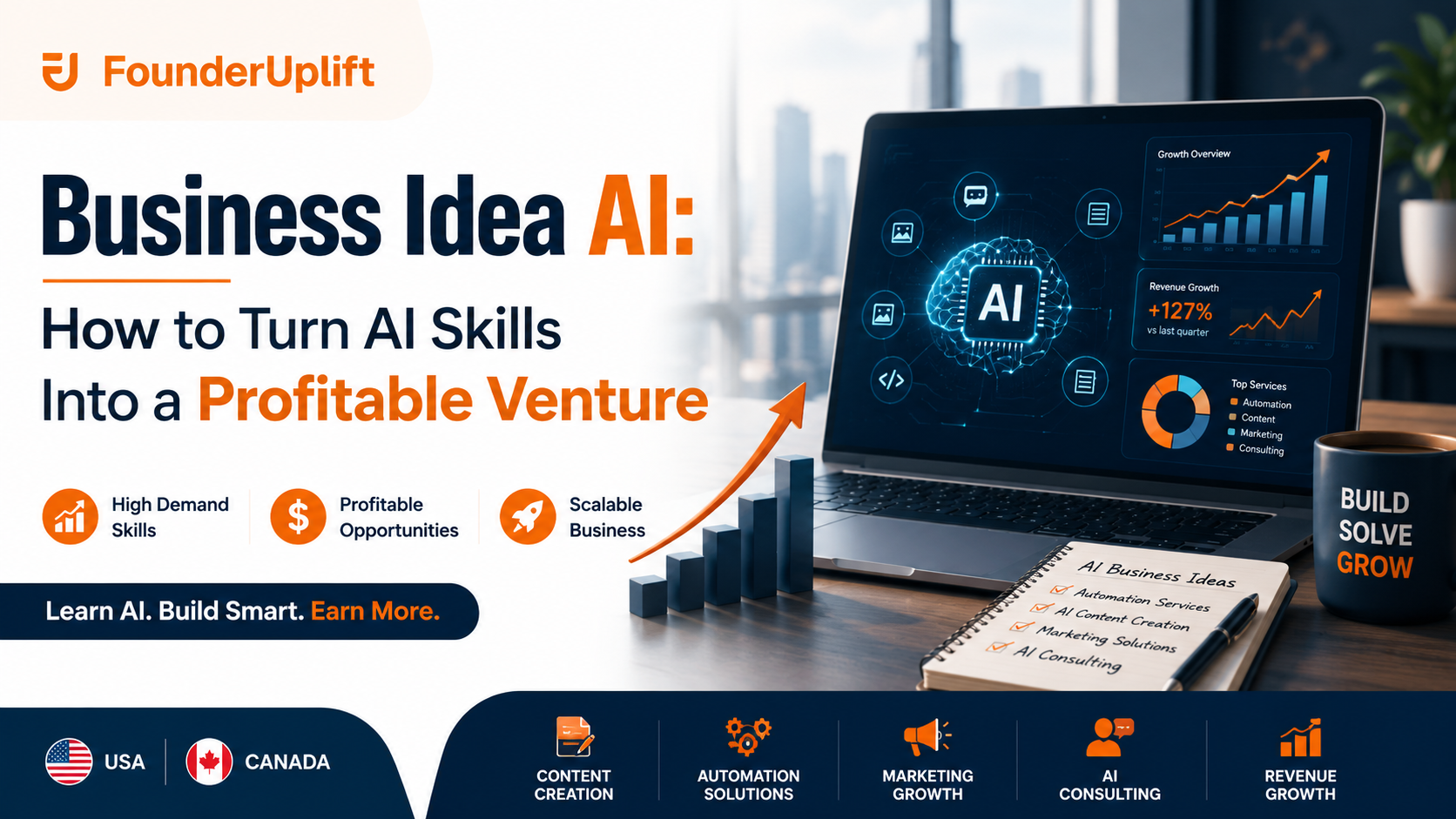
A Business Idea AI opportunity becomes valuable when artificial intelligence is connected to a real customer problem, a clear business outcome, and a model that can generate sustainable revenue. Simply knowing how to use an AI tool is no longer enough. As AI becomes easier to access, entrepreneurs need something more defensible: expertise, positioning, customer understanding, reliable processes, and measurable results.
That creates an important opportunity for freelancers, solopreneurs, marketers, consultants, developers, creators, and industry specialists. Instead of trying to invent a complicated AI platform from day one, you can use existing AI tools for business to solve problems companies already pay to fix.
For example, a marketing agency may need faster content research. An e-commerce company may want better customer support workflows. A real estate business may want quicker lead qualification. A consulting firm may need help summarizing large amounts of information. In each case, AI is not the product by itself. It is the engine behind a valuable outcome.
This FounderUplift guide explains how to turn AI skills into a profitable venture by choosing the right problem, niche, offer, business model, pricing strategy, and customer acquisition method. It also covers practical AI business ideas, AI startup ideas, AI automation, AI consulting, generative AI business models, AI side hustles, AI SaaS opportunities, and no-code AI businesses without relying on hype.
What Is a Business Idea AI Opportunity?
A Business Idea AI opportunity is a product or service that uses artificial intelligence to create measurable value for a specific customer group.
The AI component may help with research, automation, content creation, analysis, communication, design, customer service, lead generation, software development, or decision support.
However, a useful distinction is important.
AI is usually how you deliver the result.
The customer problem explains why the business exists.
How AI Skills Can Become a Real Business
Suppose you know how to use AI tools for:
content creation,
workflow automation,
market research,
SEO,
coding,
image generation,
customer support,
data organization.
Those are capabilities, not business models.
To turn one into a venture, ask:
Who needs this skill?
What business problem does it solve?
How costly is that problem?
What are customers doing now?
Why would they pay you?
Can you deliver the result repeatedly?
Turning AI Knowledge Into Customer Value
Consider two offers.
“AI automation services.”
versus:
“We help accounting firms automate repetitive client document processing and internal reporting.”
The second offer is stronger because it identifies a customer, problem, and practical outcome.
Customers Pay for Results, Not AI Tools Alone
Customers generally care about:
saving time,
reducing costs,
generating revenue,
improving response speed,
improving customer experience,
reducing repetitive work,
increasing productivity.
Therefore, your AI skill becomes commercially valuable when it contributes to one of those outcomes.
Why AI-Powered Businesses Are Growing
Artificial intelligence has reduced the cost and complexity of many business processes.
A single entrepreneur can now perform tasks that previously required multiple specialists. Meanwhile, small businesses can access capabilities that once demanded custom software or large technology budgets.
AI Is Reducing the Cost of Repetitive Work
Generative AI and automation platforms can assist with:
drafting,
summarizing,
categorizing,
researching,
organizing,
transcribing,
qualifying,
routing,
reporting.
Nevertheless, automation is most useful when the underlying business process is already understood.
Faster Workflows Create New Business Opportunities
If you understand both the technology and the customer's workflow, you can create a stronger offer than someone who simply knows how to operate a popular tool.
This is where many profitable AI business opportunities are emerging.
Who Can Start an AI-Powered Business?
You do not need to be a machine learning engineer.
Freelancers and Solopreneurs
Freelancers can use AI to increase capacity while maintaining human judgment.
Marketers and Content Creators
AI can assist with research, planning, copy development, campaign analysis, and content repurposing.
Developers and No-Code Builders
Developers can create integrations and custom applications, while no-code specialists can build practical workflows without developing everything from scratch.
Consultants and Industry Specialists
Industry expertise is particularly valuable because companies often need someone who understands both their business environment and AI.
You Do Not Need to Be an AI Engineer to Start
The ability to solve a real business problem is often more valuable than knowing the most advanced technical terminology.
Why Your AI Skills Can Become a Profitable Venture
The commercial advantage of AI comes from leverage.
AI Can Improve Productivity
AI can reduce the amount of manual work required to complete routine tasks.
Automate Time-Consuming Tasks
Good candidates include:
repetitive reporting,
standard email preparation,
research organization,
data entry,
initial support categorization,
CRM updates.
Keep Human Oversight Where Accuracy Matters
Automation should not remove human judgment from areas where mistakes can create serious consequences.
For example, strategic advice, sensitive customer communication, legal material, and financial information should receive appropriate review.
AI Can Help One Person Serve More Customers
A well-designed AI workflow can increase capacity without proportionally increasing labour.
Build Repeatable Workflows
If the same sequence produces consistent results, it can eventually become a documented process.
Standardized Delivery Makes Scaling Easier
That process may later become:
a productized service,
a recurring subscription,
an AI SaaS product,
an internal platform.
Step 1: Identify the AI Skills You Can Monetize
Before searching for business ideas, audit your existing abilities.
AI Writing and Content Creation
Possible services include:
email campaigns,
product descriptions,
website copy,
content briefs,
research summaries.
However, raw AI output is easy to reproduce.
The value comes from editing, strategy, fact-checking, subject knowledge, and brand alignment.
AI Marketing Skills
AI can support:
SEO research,
social media planning,
customer segmentation,
advertising research,
campaign development,
reporting.
AI Automation Skills
Automation is attractive because its value is often measurable.
Examples include:
lead routing,
automated follow-up,
document processing,
internal reporting.
AI Design Skills
Possible services include:
ad creatives,
social graphics,
presentation visuals,
mockups,
branded content.
AI Video and Audio Skills
You may offer:
short-form video,
explainer content,
AI-assisted editing,
content repurposing,
voiceover workflows.
AI Development Skills
More technical opportunities include:
custom chatbots,
API integrations,
AI agents,
internal applications,
SaaS tools.
Separate Basic Tool Usage From Valuable Expertise
Using an AI platform is easy to learn.
Solving a business problem consistently is harder.
Domain Knowledge Makes AI Skills More Valuable
A marketer who understands e-commerce can create more relevant automation than someone who knows automation tools but does not understand online retail.
Step 2: Match Your AI Skills With Real Customer Problems
A strong AI startup idea begins with a problem.
Start With the Problem Instead of the Technology
Look for activities that are:
expensive,
slow,
repetitive,
error-prone,
difficult to scale.
Look for Expensive or Repetitive Tasks
The more economic impact a problem creates, the easier it may be to justify paying for a solution.
High-Cost Problems Are Often Easier to Monetize
Saving ten minutes once a year creates little value.
Saving ten employee hours every week may create a strong business case.
Step 3: Choose a Profitable AI Business Niche
Trying to serve everyone makes positioning weaker.
Why Niche Selection Matters
A niche helps you understand:
customer language,
workflows,
buying behaviour,
common objections,
business economics.
Specific Positioning Makes Marketing Easier
Compare:
“AI consulting for businesses.”
with:
“AI workflow automation for independent real estate agencies.”
The second is easier for a buyer to understand.
Avoid Trying to Serve Every Industry
Start narrow.
You can expand after proving demand.
12 Business Idea AI Models You Can Build From Your Skills
1. AI Content Strategy Service
Help businesses plan, research, and produce content more efficiently.
Services You Can Offer
Content briefs, SEO research, editorial planning, blog creation, and content refreshes.
Ideal Customers
SaaS companies, agencies, professional services, and e-commerce brands.
2. AI-Powered SEO Service
AI can accelerate parts of SEO research.
AI Tasks That Support SEO
Keyword clustering, competitor research, entity identification, content planning, and metadata drafting.
Human Expertise Still Matters
Search intent, content quality, E-E-A-T, technical SEO, and cannibalization decisions still need strong judgment.
3. AI Social Media Management Business
Offer content planning, captions, repurposing, and publishing support.
How to Differentiate
Specialize in one industry.
For example, social media management for fitness studios is clearer than a generic social media service.
4. AI Marketing Automation Service
Automate repetitive marketing workflows.
Processes You Can Automate
Lead follow-up, CRM updates, email sequences, reporting, and segmentation.
Sell the Outcome
“Reduce missed leads” is more compelling than “AI-powered workflow integration.”
5. AI Chatbot Development Service
Businesses may use chatbots for support and lead qualification.
Common Business Use Cases
FAQs, product guidance, appointment requests, customer support, and initial lead screening.
6. AI Lead Generation Business
Use AI to improve prospect research and personalization.
Important Metrics
Track qualified leads, meetings, opportunities, and sales rather than the number of messages sent.
7. AI Video Creation Service
Businesses increasingly need more video content.
Services
Short videos, ads, explainers, educational clips, and product demonstrations.
8. AI Design and Creative Service
Use AI to accelerate creative production.
Deliverables
Ad concepts, social graphics, mockups, presentations, and campaign visuals.
Why Human Judgment Matters
Brand consistency and quality control differentiate professional work from generic output.
9. AI Research and Market Intelligence Service
Help businesses organize complex information.
Services
Competitor analysis, customer research, market summaries, and trend reports.
Verify Important Information
AI-generated research should never be treated as automatically correct.
10. AI Virtual Assistant Business
Assist founders or professionals with routine tasks.
Tasks
Research, scheduling, documentation, summaries, and administration.
Increase Value Through Specialization
An assistant specializing in legal administration, for example, can create a stronger offer than a generic VA.
11. AI Digital Product Business
Create reusable resources.
Products
Templates, workbooks, checklists, prompt systems, and workflow guides.
Avoid Generic Products
“500 AI prompts” is easy to copy.
A detailed onboarding system for freelance designers solves a clearer problem.
12. AI Consulting and Training Business
Organizations increasingly need help understanding practical AI adoption.
Services
Tool selection, staff training, workflow redesign, internal policies, and implementation guidance.
Expertise Matters
Consulting becomes more valuable when AI knowledge is combined with industry experience.
Step 4: Validate Your Business Idea AI Before Investing
Validation helps you avoid building too early.
Define the Customer Problem Clearly
Write:
“[Customer] experiences [problem], which causes [economic or operational impact].”
Interview Potential Customers
Ask:
How do you solve this now?
What frustrates you?
What does it cost?
What have you already tried?
Who approves purchases?
Focus on What Customers Already Do and Pay For
Past behaviour is generally more informative than hypothetical answers.
Analyze Existing Competitors
Competition can confirm commercial demand.
Look at:
pricing,
positioning,
reviews,
customer segments,
strengths,
weaknesses.
Look for Repeated Customer Complaints
Repeated complaints can reveal opportunities, but only if customers care enough to change providers.
Test Demand With a Landing Page
Describe your offer clearly and use one CTA.
Examples include:
Book a demo
Join a waitlist
Request a consultation
Start a pilot
Measure Qualified Interest
Traffic alone does not prove demand.
Run a Paid Pilot
Payment provides stronger validation than compliments.
A paid pilot can reveal:
what customers value,
delivery challenges,
pricing objections,
workflow improvements.
Step 5: Create an AI Offer Customers Understand
Sell Outcomes Instead of AI Features
Weak:
“Advanced AI automation solutions.”
Better:
“We automate repetitive lead follow-up so service businesses respond faster to potential customers.”
Focus on Business Results
The second message communicates a clear outcome.
Build a Strong Value Proposition
Your offer should explain:
who you help,
what you solve,
what result you create,
why you are different.
Communicate the Value in One Clear Sentence
If customers need several minutes to understand the offer, simplify it.
Step 6: Choose the Right AI Business Model
Freelance AI Services
Useful for testing demand quickly.
Monthly Retainer Model
Suitable for ongoing content, SEO, automation support, or lead generation.
Productized AI Service
Standardize your deliverables, scope, and pricing.
Subscription Model
Deliver ongoing value in exchange for recurring payments.
AI SaaS Business
Turn a repeated workflow into software after validating demand.
Digital Product Model
Sell reusable resources at scale.
However, distribution and customer acquisition still matter.
Step 7: Price Your AI Services for Profit
Avoid Pricing Only by Hours Worked
AI may help you work faster.
That does not mean the customer receives less value.
Faster Delivery Does Not Automatically Reduce Customer Value
If a workflow saves a company significant time every month, the economic outcome may justify strong pricing.
Use Value-Based Pricing Where Appropriate
Consider:
time saved,
additional revenue,
productivity,
risk reduction,
cost savings.
Create Clear Pricing Packages
You might offer:
Starter
Growth
Premium
Each package should have a clear difference in scope or result.
Calculate Your Real Delivery Costs
Include:
software,
API usage,
labour,
contractors,
customer support.
Revenue Does Not Equal Profit
A high-revenue service can still have weak margins.
Step 8: Build a Minimum Viable AI Offer
Start With the Simplest Useful Version
Do not build complex software before proving the core value.
Deliver Manually Before Automating Everything
Manual delivery helps you understand the customer's real workflow.
Automate Only After the Process Is Proven
Automation works best once you know which steps are repeatable.
Document the Delivery Process
Create SOPs for:
inputs,
steps,
quality checks,
outputs.
Systems Make Scaling Easier
Well-documented workflows allow future delegation and automation.
Step 9: Get Your First Customers for an AI Business
Use Direct Outreach
Target businesses with the specific problem you solve.
Avoid generic sales messages.
Use LinkedIn for B2B Lead Generation
Publish useful content covering:
common mistakes,
implementation advice,
case studies,
AI limitations,
workflow opportunities.
Use SEO and Content Marketing
Create content around searches such as:
AI automation for small business,
AI consulting,
AI marketing services,
AI tools for business,
generative AI for business,
AI business ideas.
Answer the searcher's question completely instead of creating thin content.
Generate Referrals
Satisfied customers can reduce future acquisition costs.
Build Strategic Partnerships
Partner with businesses offering complementary services.
Step 10: Build E-E-A-T Around Your AI Business
E-E-A-T means Experience, Expertise, Authoritativeness, and Trustworthiness.
Demonstrate Experience
Show real workflows, case studies, and project lessons.
Real Experience Builds More Trust Than Generic Claims
Avoid invented statistics or fabricated customer success stories.
Demonstrate Expertise
Publish useful content that explains both benefits and limitations.
Build Authoritativeness
Develop a recognizable niche.
Strengthen Trustworthiness
Be clear about:
AI usage,
data handling,
fact-checking,
human review,
pricing.
Responsible AI Use Can Become a Competitive Advantage
Trust becomes increasingly important as AI-generated services become common.
How to Use AI Responsibly in a Commercial Business
Protect Customer Privacy
Understand how your tools process information.
Avoid sending confidential customer data into systems without appropriate safeguards.
Verify AI-Generated Information
AI can make mistakes.
Human Review Should Remain Part of Quality Control
Review high-impact outputs carefully.
Understand Copyright and Licensing
Commercial usage rights can vary by platform and asset type.
Be Transparent With Customers
Do not misrepresent automated work as something else when that distinction matters.
Best AI Tools for Starting an AI-Powered Venture
The best stack is the one that solves your customer's problem reliably.
AI Writing and Research Tools
Useful for research, summarization, drafting, and ideation.
AI Automation Tools
Useful for connecting systems and triggering workflows.
AI Design Tools
Useful for concepts and marketing assets.
AI Video and Audio Tools
Useful for content creation and repurposing.
AI Coding Tools
Useful for prototypes, integrations, and development support.
Compare Cost, Accuracy, Privacy, and Integration
Do not collect subscriptions simply because tools are popular.
Use the Smallest Tool Stack That Solves the Problem
Lower complexity often improves reliability and profitability.
How Much Does It Cost to Start a Business Idea AI Venture?
Service businesses are generally cheaper to test than software products.
Essential Startup Costs
Possible costs include:
AI software,
domain,
website,
communication tools,
basic business operations.
Start Lean Until Demand Is Proven
Avoid expensive development before customer evidence exists.
Optional Startup Costs
These may include:
advertising,
premium automation,
contractors,
custom software.
Increase Spending Only When Evidence Supports Growth
Investment should rise as uncertainty decreases.
How to Calculate Profitability for Your AI Venture
Estimate Revenue
Multiply average customer revenue by the number of customers.
Create realistic scenarios rather than one optimistic forecast.
Calculate Delivery Costs
Include software, labour, API usage, and fulfilment.
Calculate Customer Acquisition Cost
CAC measures what you spend to gain a customer.
Estimate Customer Lifetime Value
LTV reflects the economic value a customer may generate over time.
Recurring Customers Can Improve Long-Term Profitability
Retention often makes a major difference in subscription and retainer businesses.
Common Mistakes When Turning AI Skills Into a Business
Selling AI Instead of Solving a Problem
Technology is not a complete value proposition.
Customers Buy Results
Lead with the result.
Choosing a Market Only Because AI Is Trending
Popularity does not guarantee sustainable demand.
Offering Too Many AI Services
Broad positioning reduces relevance.
Start with one clear offer.
Underpricing AI-Assisted Work
Faster delivery does not automatically mean lower value.
Depending on One AI Platform
Providers, pricing, and features can change.
Build flexible workflows.
Ignoring Human Quality Control
Automation can introduce errors.
Human oversight protects credibility.
How to Make Your Business Idea AI Stand Out From Competitors
Specialize in a Clear Niche
Become known for solving one meaningful problem.
Build Proprietary Workflows
Your combination of tools, processes, expertise, and quality control can become harder to copy than any individual AI application.
Create Case Studies
Explain:
Problem → Approach → Result
Real evidence improves buyer confidence.
Build a Recognizable Brand
As AI becomes more accessible, trust and reputation become stronger differentiators.
How to Scale a Profitable AI Business
Standardize Your Service
Turn repeatable delivery into systems.
Automate Low-Judgment Work
Keep humans involved in important decisions.
Hire or Outsource Strategically
Delegate repeatable activities while protecting strategy and quality.
Move From Service to Product
Repeated customer requests can reveal opportunities for software, templates, or subscriptions.
Build Recurring Revenue
Recurring value can improve predictability.
How to Know When Your Business Idea AI Is Working
Your venture is becoming stronger when:
customers understand the offer quickly,
prospects willingly pay,
customers return,
referrals appear,
delivery becomes repeatable,
margins improve.
Customers Are Willing to Pay
Payment is stronger evidence than social engagement.
Customers Continue Using the Service
Retention shows continued value.
Customers Recommend Your Business
Referrals can indicate satisfaction.
Delivery Becomes Repeatable
Repeatability is important for scaling.
Business Idea AI With FounderUplift
FounderUplift's practical approach is straightforward: use AI as leverage, not as the entire business.
Turn AI Skills Into Customer Outcomes
Start with a clearly defined audience and problem.
Validate Before Investing Heavily
Test your offer with real customers.
Build Beyond One AI Tool
Combine:
expertise,
customer relationships,
systems,
brand,
distribution.
Sustainable Businesses Create Value Beyond Technology Access
Tools change quickly. Strong customer value lasts longer.
Final Thoughts: Turn Your Business Idea AI Into a Profitable Venture
A profitable Business Idea AI venture is not built by chasing every new model, platform, or AI trend.
It is built around customers.
Start by identifying what you can do well. Then find a customer problem that is painful, expensive, repetitive, or difficult to solve.
Next, choose a narrow market.
Validate the problem.
Test your offer.
Ask customers to pay.
Deliver manually if necessary.
Document what works.
Only then should you automate and scale.
The strongest AI businesses will not necessarily be the ones using the most advanced technology. Instead, they will be the businesses that combine technology with expertise, trust, distribution, customer knowledge, and reliable execution.
Use AI to increase leverage.
Do not allow AI to replace critical thinking.
Ultimately, the question is not:
“What can AI do?”
The more useful question is:
“What valuable customer problem can I solve better because AI exists?”
That is where a sustainable AI-powered venture begins.
Frequently Asked Questions About Business Idea AI
1. What Is a Business Idea AI Opportunity?
A Business Idea AI opportunity is a product or service that uses artificial intelligence to solve a specific customer problem or improve an existing workflow. Examples include AI automation, content services, chatbots, research, digital products, consulting, and AI SaaS.
2. What AI Skills Can I Turn Into a Business?
Commercially useful skills include AI writing, marketing, SEO, automation, design, video production, chatbot development, research, coding, and consulting. Your strongest opportunity usually appears when an AI skill is combined with expertise in a particular industry or business process.
3. Can I Start an AI Business Without Coding?
Yes. Many AI business ideas do not require programming. Content services, consulting, social media management, no-code automation, research, digital products, virtual assistance, and AI training can all be started without advanced coding knowledge.
4. How Do I Find Customers for an AI Business?
Define one target audience and one problem first. Then use direct outreach, LinkedIn, SEO, educational content, referrals, partnerships, industry communities, and relevant social media platforms. Your marketing should focus on the customer's desired outcome rather than AI terminology.
5. How Do I Know If My AI Business Is Profitable?
Track revenue, software costs, labour, gross margin, customer acquisition cost, retention, and customer lifetime value. A business is not truly profitable simply because it generates sales; delivery and acquisition costs must also remain sustainable.
6. How Much Money Do I Need to Start an AI Business?
The required investment depends on the model. AI-assisted service businesses may need only basic software, a website, and communication tools. Custom AI SaaS products usually require more development resources. Starting with a service can help validate demand before you invest heavily.
7. What Is the Best AI Business Model for Beginners?
A specialized AI-assisted service is often practical for beginners because it can be tested with relatively low capital. You can work directly with customers, learn their problems, improve the process, and later convert the workflow into a productized service or software.
8. How Should I Price AI Services?
Pricing should account for the value created, your expertise, delivery expenses, risk, support, and customer outcomes. Do not automatically charge less just because AI makes the work faster. Project fees, retainers, tiered packages, and value-based pricing can all work depending on the service.
9. How Can I Differentiate an AI Business?
Choose a narrow niche, understand the industry's workflows, build proprietary processes, maintain human quality control, publish useful expertise, and document real customer results. Generic access to AI tools is easy to copy; specialized knowledge and trusted execution are more defensible.
10. Can an AI Business Stay Profitable as AI Tools Improve?
Yes, provided the business offers value beyond access to a particular tool. Expertise, distribution, brand trust, proprietary systems, customer relationships, data, integrations, and industry knowledge can create more durable competitive advantages as AI technology becomes increasingly accessible.