
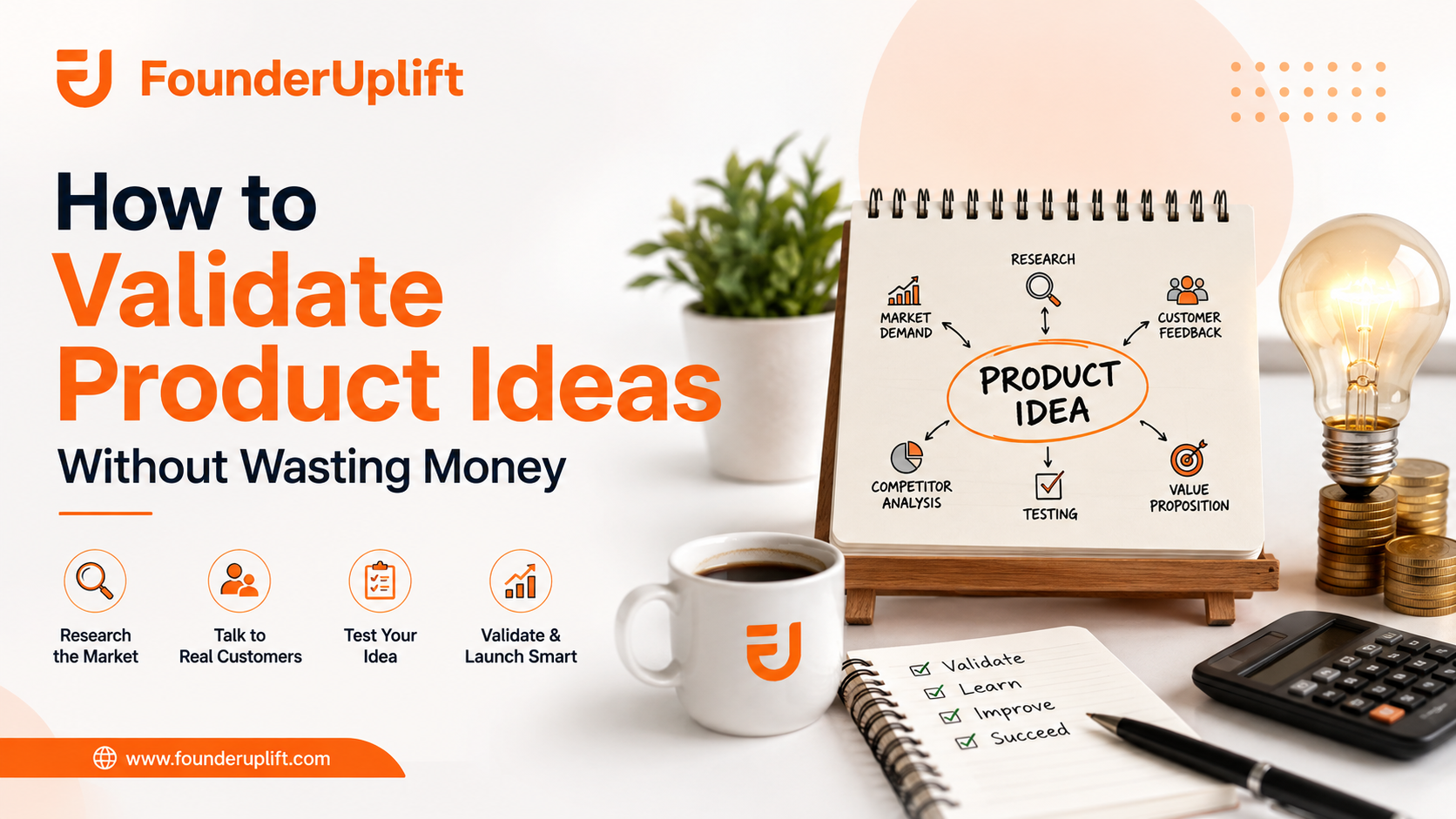
If you want to validate product ideas before investing serious money, the goal is not to prove that your idea is brilliant. Instead, the goal is to collect enough real-world evidence to determine whether a specific group of customers has a meaningful problem, wants your solution, and may be willing to pay for it.
Many founders make the opposite move. They spend months designing features, hiring developers, ordering inventory, building a polished website, and preparing marketing campaigns before they know whether genuine demand exists. As a result, they can end up with a technically impressive product that solves a weak problem—or solves the right problem for the wrong audience.
Product validation helps you reduce that risk.
Rather than betting heavily on assumptions, you test those assumptions one by one. You research the market, speak with potential customers, study competitors, test messaging, build lightweight prototypes, measure demand, and look for evidence of buying intent.
For founders, startups, entrepreneurs, and small businesses, this approach can save both money and time. More importantly, it creates a stronger foundation for product-market fit.
This guide from FounderUplift explains how to validate product ideas methodically without wasting your budget.
What Does It Mean to Validate Product Ideas?
Product validation is the process of testing whether a proposed product solves a real customer problem and has enough market demand to justify further investment.
In simple terms, you are trying to answer several questions:
Does the problem genuinely exist?
Who experiences the problem most often?
How serious is it?
How are people solving it today?
Are current solutions inadequate?
Does your proposed solution make sense to customers?
Would people take meaningful action to get it?
Would enough customers potentially pay for it?
Therefore, product validation is much more than asking people, “Do you like my idea?”
People often say they like concepts because they want to be supportive. However, compliments are weak evidence.
Customer behavior is stronger evidence.
Someone joining a waitlist is more meaningful than saying, “That sounds interesting.” A person requesting a demo is stronger still. A pre-order or payment is among the strongest validation signals because money creates genuine commitment.
Why Product Validation Matters Before You Invest
Every new product contains uncertainty.
You may be uncertain about the problem, audience, solution, pricing, marketing channel, product features, or willingness to pay.
Validation helps reduce those uncertainties before you commit significant resources.
It cannot guarantee success. No validation method can completely predict how the market will behave after launch. Nevertheless, good validation can expose weak assumptions early, when changing direction is still relatively inexpensive.
Product Validation vs Product Development
Product development asks:
How should we build the product?
Product validation asks:
Should we build this product, for whom, and in what form?
That distinction matters.
Why Validation Should Come First
Building too early locks your assumptions into code, inventory, processes, and financial commitments.
Validation keeps your options open.
Therefore, before building a sophisticated solution, validate the underlying customer problem and demand.
What Makes a Product Idea Worth Validating?
Not every idea deserves months of research. However, almost every serious business idea deserves some form of validation before substantial investment.
A promising idea usually sits at the intersection of three factors.
Problem-Solution Fit
Your product should address a specific and recognizable problem.
For example, “help businesses become more productive” is too broad.
In contrast, “help freelance designers automatically track billable project time without manually creating timesheets” describes a clearer problem.
The more specific the problem, the easier it becomes to conduct meaningful product idea validation.
Customer Demand
A problem can exist without creating a viable market.
Someone may find an inconvenience annoying but not care enough to change their behavior.
Therefore, market validation should investigate whether customers actively seek solutions, compare alternatives, ask questions, complain about existing options, or spend money trying to solve the problem.
Willingness to Pay
A useful idea is not automatically a viable business.
Eventually, your economics have to work.
Consequently, product validation should examine whether customers value the outcome enough to exchange money, time, data, effort, or another meaningful resource for your solution.
Why You Should Validate Product Ideas Before Spending Money
The most valuable benefit of validation is not simply saving money. It is improving decision quality.
Reduce the Risk of Building the Wrong Product
Founders naturally become attached to their ideas. After thinking about a solution repeatedly, assumptions can begin to feel like facts.
They are not.
Your target market may define the problem differently. Customers may value different features. They may already have an acceptable workaround. Alternatively, a competitor might solve the problem more effectively than you realized.
Avoid Assumptions About Customer Needs
Instead of assuming, document what you believe.
For example:
Small e-commerce sellers struggle to create product descriptions quickly enough.
That is a hypothesis.
Turn Assumptions Into Testable Hypotheses
A stronger version might be:
Independent e-commerce sellers with more than 100 products spend several hours each week writing or editing product descriptions and would consider paying for a faster workflow.
Now you can test:
Who experiences the problem?
How frequently?
How much time does it consume?
How do sellers solve it now?
What solutions have they purchased?
How important is speed?
This makes the validation process measurable.
Save Time, Money, and Resources
An inexpensive discovery process can prevent an expensive development mistake.
Before hiring a full development team, manufacturing inventory, or signing long-term contracts, test the riskiest assumptions.
Discover What Customers Actually Want
Founders often think in terms of features.
Customers usually think in terms of outcomes.
They may not want “AI-powered workflow automation.” They may want to finish repetitive administrative tasks before lunchtime.
Understanding the outcome changes how you design, position, and market your product.
How to Validate Product Ideas Step by Step
A strong product validation process moves from low-cost learning to higher-commitment testing.
Step 1: Define the Problem Your Product Solves
Before testing your solution, clarify the problem.
Ask:
What exactly is happening?
Who experiences it?
When does it happen?
Why is the current situation frustrating?
What happens if customers do nothing?
Identify the Specific Customer Pain Point
The best validation questions focus on real behavior.
Instead of asking:
“Would you use an app that manages business expenses?”
Ask:
“How do you currently track business expenses?”
Then follow with:
“What is the hardest part of that process?”
These questions generate evidence rather than hypothetical enthusiasm.
Ask Whether the Problem Is Urgent Enough to Solve
Some problems are real but low priority.
If people complain yet repeatedly refuse to spend money, switch tools, or change behavior, the pain may not be strong enough.
Urgency matters because customers have limited budgets and attention.
Define Your Target Customer
“Small businesses” is rarely a useful starting audience.
Narrow it.
For example:
“Independent Shopify merchants selling 50–500 products.”
That specificity improves customer research, advertising experiments, interviews, landing page copy, and competitor analysis.
Step 2: Research Your Target Market
Good market research does not require a huge budget.
Begin by studying where your target customers already communicate.
Look at:
Google search behavior
Industry forums
Reddit discussions
YouTube comments
Facebook groups
LinkedIn conversations
Software reviews
Marketplace reviews
Competitor testimonials
Community discussions
Analyze Market Demand
Look for evidence that people actively care about the problem.
Strong signs include customers repeatedly asking how to solve it, comparing tools, complaining about poor alternatives, and looking for recommendations.
Look for Existing Search and Buying Behavior
Keywords such as product validation, market validation, validate startup idea, validate business idea, minimum viable product, product-market fit, and customer validation exist because founders are actively searching for ways to reduce uncertainty.
Use the same principle within your market.
If potential buyers search for solutions, compare products, and investigate costs, that behavior can indicate commercial demand.
Step 3: Research Your Competitors
Competition does not automatically mean your idea is bad.
In fact, competition can confirm that customers already spend money within the category.
Identify Direct and Indirect Competitors
Direct competitors solve the same problem in a similar way.
Indirect competitors solve the same underlying problem differently.
Suppose you are building automated meeting software. Your competitors are not only other AI meeting platforms. They may also include human assistants, manual notes, project-management tools, or simply recording calls.
Find Gaps in Existing Products
Study customer reviews carefully.
Look for repeated complaints involving:
price
usability
missing features
poor support
complexity
reliability
integrations
speed
accessibility
Analyze Negative Reviews and Customer Complaints
One complaint may be personal preference.
Fifty similar complaints may indicate a market gap.
However, avoid assuming every complaint represents an opportunity. Customers may dislike something but still consider it unimportant.
Therefore, investigate whether the complaint affects purchasing or retention.
Step 4: Talk to Potential Customers
Customer interviews remain one of the lowest-cost ways to validate product demand.
Ideally, speak with people who actually match your proposed customer profile.
Conduct Customer Interviews
Focus on past and present behavior.
Useful questions include:
When did you last experience this problem?
What happened?
How did you solve it?
What did that solution cost?
What frustrated you?
Have you tried another solution?
Why did you stop using it?
Who makes the buying decision?
Avoid Leading Questions
Avoid asking:
“Wouldn’t it be easier if our product automated this?”
That question pushes the customer toward your preferred answer.
Instead ask:
“How would you ideally want this process to work?”
Ask About Past Behavior Instead of Future Intentions
Past behavior is generally more reliable than hypothetical promises.
Someone saying, “I would definitely pay for that,” is useful but weak.
Someone saying, “I already pay $100 every month to solve this,” provides much stronger information.
Step 5: Create a Simple Value Proposition
Once you understand the problem, summarize your offer clearly.
A useful value proposition explains:
who the product is for,
what problem it solves,
what outcome it creates,
why it is different.
For example:
“FounderUplift helps early-stage founders test product demand before committing significant time and money to development.”
Clear positioning also helps you evaluate whether customers understand the product immediately.
Test Different Value Propositions With Real Users
You may discover that different benefits resonate with different segments.
For example, one audience may care primarily about saving money, while another values speed.
Test messaging rather than relying on your personal preference.
Step 6: Build a Minimum Viable Test
You do not always need a functioning product to validate demand.
Instead, create the smallest experiment capable of testing your biggest assumption.
Create a Landing Page
A simple landing page can describe:
the problem,
your proposed solution,
key benefits,
who it is for,
a clear call to action.
Your CTA could be:
Join the waitlist
Request early access
Book a demo
Start a trial
Reserve your spot
Pre-order
Measure Sign-Ups, Clicks, or Purchase Intent
Traffic alone does not validate a product.
You need action.
If 1,000 highly relevant visitors arrive and almost nobody responds to your proposition, investigate why.
Perhaps the audience is wrong. Alternatively, the problem may be weak, your messaging may be unclear, or your solution may not be compelling.
Step 7: Create a Prototype or MVP
A minimum viable product, or MVP, should test the central value of your idea with minimal unnecessary development.
An MVP does not mean building a low-quality product.
It means building only enough to learn.
Use a Prototype or Mockup
For software, this might be a clickable design.
For a physical product, it might be a simplified sample.
For a service, it may be a manual process.
Test the Core Product Experience Before Development
Ask users to complete realistic tasks.
Watch what they do rather than explaining every step.
Where do they hesitate?
What do they misunderstand?
Which features do they ignore?
What do they immediately ask for?
These observations can be more valuable than a long survey.
Step 8: Test Willingness to Pay
This is where many ideas encounter reality.
Positive feedback is encouraging, but successful businesses require economic value.
Why Positive Feedback Is Not Enough
Imagine 100 people say:
“That is a great idea.”
Now imagine only two are willing to pay.
Your validation story changes dramatically.
Separate Interest From Buying Intent
Stronger validation signals include:
deposits
pre-orders
paid pilots
signed contracts
subscription commitments
trial-to-paid conversions
The greater the commitment, the more meaningful the evidence.
Low-Cost Ways to Validate Product Ideas
You do not need a large startup budget to test early assumptions.
Create a Landing Page Before Building
A focused landing page can test both messaging and demand.
Include one primary action rather than several competing CTAs.
What to Include
Your page should answer:
What is the problem?
Who has the problem?
What does your solution do?
Why should they care?
What should they do next?
Run Customer Surveys
Surveys are useful when combined with interviews.
However, avoid asking only multiple-choice questions.
Include opportunities for customers to describe their experience in their own words.
Questions to Ask
Ask about:
current problems
current solutions
frequency
frustrations
spending behavior
priorities
decision criteria
Survey responses can reveal patterns you later explore through interviews.
Test Product Demand Through Social Media
Social channels can provide early qualitative feedback.
Publish content about the problem before repeatedly promoting your product.
Notice which problems generate:
comments
saves
shares
questions
direct messages
However, social engagement alone does not equal commercial validation.
A viral post can attract attention without purchase intent.
Therefore, connect engagement to stronger actions such as landing page visits, waitlist registrations, demos, or purchases.
Use Search Data to Validate Product Demand
Search behavior can reveal how customers describe problems.
This is useful for both SEO strategy and product positioning.
For example, founders might internally call a product “automated financial optimization software,” while customers search “how to reduce business expenses.”
The customer's language should influence your content, landing pages, and product messaging.
Analyze Search Intent
Separate queries into categories such as:
informational
comparison
commercial
transactional
Commercial searches often reveal stronger buying intent than general educational searches.
How to Validate Product-Market Demand
Demand validation asks whether enough people genuinely care about the problem.
Signs Your Target Market Has Real Demand
Look for multiple signals rather than one metric.
Positive signals include:
people already pay for alternatives,
customers repeatedly complain,
active communities discuss the problem,
competitors continue entering the market,
customers manually create workarounds,
users actively search for solutions.
Existing Competition Can Be a Positive Validation Signal
A completely competition-free market may sound attractive.
However, sometimes it means the market does not exist.
Strong competitors prove that buyers are willing to spend money.
Your task is not necessarily to invent a category. Instead, you may succeed by serving a segment better, solving one frustration more effectively, simplifying the experience, or changing the business model.
How to Validate Product Ideas With Real Customers
Real customers should shape your assumptions before development becomes expensive.
Where to Find Your First Test Customers
Start where your target audience already gathers.
Potential sources include:
LinkedIn
Reddit
niche forums
professional communities
Facebook groups
newsletters
existing customer lists
startup networks
industry events
The goal is not to collect hundreds of random opinions.
Ten conversations with genuinely relevant prospects can be more useful than 500 responses from people who would never buy.
What Questions Should You Ask Potential Customers?
Ask questions that reveal behavior.
For example:
What Is Your Biggest Challenge With This Problem?
This reveals how the customer prioritizes pain.
How Do You Solve This Problem Today?
Existing solutions tell you what you are competing against.
What Do You Dislike About Existing Solutions?
Recurring dissatisfaction can reveal opportunity.
Have You Paid for a Solution Before?
This question is particularly useful because past spending demonstrates willingness to solve the problem.
Why Behavior-Based Questions Produce Better Insights
Intentions are uncertain.
Behavior already happened.
Therefore, when possible, use evidence from real decisions rather than imagined future decisions.
How to Validate a Product Without Building It
One of the biggest misconceptions in entrepreneurship is that you must build before you can validate.
You often do not.
Use a Fake-Door Test
A fake-door experiment displays a proposed feature or offer before full development.
For example, you may add a “Generate automatically” button inside a prototype. If users click it frequently, that behavior signals interest.
However, the experience should remain transparent. Do not mislead customers into believing a nonexistent product has already been delivered.
Use Product Mockups
High-quality mockups make abstract products easier to understand.
You can test:
packaging
interface concepts
pricing tiers
value propositions
feature priorities
Ask customers what they think the product does before explaining it.
If they repeatedly misunderstand the concept, your positioning may need work.
Use Pre-Sales to Test Demand
Pre-sales can create powerful validation because customers make a real commitment.
However, clearly explain expected delivery timelines, refund terms, and what the customer is purchasing.
Trust matters more than short-term conversion.
Offer the Service Manually First
Many scalable businesses begin with a manual version.
Imagine you plan to build software that automatically creates weekly marketing reports.
Before spending months coding the platform, you could manually create reports for five customers.
This experiment helps reveal:
what data matters,
what customers ignore,
which reports create value,
how frequently users need updates.
Once the process becomes clear, automation becomes more informed.
Product Validation Metrics You Should Track
Metrics help you separate intuition from evidence.
Landing Page Conversion Rate
Track how many qualified visitors complete your target action.
However, there is no universal “good” conversion rate.
Results depend on traffic quality, offer, market, price, trust, and CTA.
Therefore, compare experiments rather than relying blindly on benchmarks.
Customer Interview Patterns
Record repeated:
pain points
objections
buying triggers
current solutions
terminology
desired outcomes
Look for patterns across customers rather than reacting to one unusual comment.
Willingness-to-Pay Signals
Create a hierarchy of evidence.
For example:
Like < click < email signup < demo request < trial < deposit < purchase.
The stronger the commitment, the stronger the validation signal.
Customer Acquisition Cost
Eventually, determine whether customer acquisition economics could support the business.
A product can attract paying customers yet still fail if obtaining each customer costs more than the customer generates in sustainable value.
Common Product Validation Mistakes That Waste Money
Building the Full Product Too Early
This is one of the most expensive mistakes.
Instead, identify the assumption that could destroy the business if it is false.
Test that assumption first.
Asking Friends and Family for Validation
People close to you may encourage your idea.
Their support is valuable emotionally but often weak commercially.
Prioritize target customers who have no reason to protect your feelings.
Asking Customers Whether They “Like” the Idea
Customers do not need to like your presentation.
They need to care enough about the outcome to act.
Measure action.
Spending Too Much on Paid Advertising
Paid ads can help validate messaging and acquisition channels.
However, early testing should remain controlled.
Begin with small experiments, learn what works, and expand gradually.
Ignoring Negative Feedback
Negative feedback can be uncomfortable, but it is often valuable.
Do not automatically implement every complaint. Instead, investigate repeated objections.
If five target customers independently raise the same concern, examine it seriously.
How Much Should You Spend to Validate Product Ideas?
There is no universal budget.
Instead, spend the smallest amount necessary to answer your most important question.
Free Validation Methods
Start with:
customer interviews
community research
competitor analysis
surveys
search research
manual prototypes
Low-Cost Validation Methods
Next, consider:
landing pages
no-code tools
interactive prototypes
small advertising campaigns
limited production samples
When Should You Invest More Money?
Increase spending when evidence becomes stronger.
For example:
Research confirms the problem.
Then interviews confirm urgency.
Next, landing pages confirm messaging.
Finally, payment experiments confirm willingness to pay.
At every stage, uncertainty decreases.
This staged approach protects capital.How Long Should Product Validation Take?
Product validation is not one event.
It is a sequence.
Problem Validation
Confirm that the problem exists.
Solution Validation
Confirm that customers understand and value your proposed solution.
Demand Validation
Measure whether customers take meaningful action.
Pricing Validation
Test whether the business can capture sufficient value.
A simple idea may move through early tests quickly, while complex B2B or regulated products may require longer validation.
Therefore, focus less on an arbitrary timeline and more on the strength of evidence.
How to Know When Your Product Idea Is Validated
A product is not “validated” simply because five people liked it.
Look for a combination of signals.
Customers Consistently Describe the Same Problem
Repeated language indicates shared pain.
Customers Actively Search for Solutions
Active searching suggests awareness and urgency.
People Sign Up, Pre-Order, or Pay
Actions indicate commitment.
Your Value Proposition Is Easy to Understand
Customers should quickly grasp the core benefit.
Customers Prefer Your Solution Over Alternatives
Your advantage does not need to be revolutionary.
It simply needs to be meaningful enough for a defined customer segment.
Strong Validation Signals vs Weak Validation Signals
Weak signals:
likes
compliments
survey enthusiasm
social impressions
Stronger signals:
demos
trials
deposits
pre-orders
paid pilots
recurring use
referrals
Ultimately, actions matter more than opinions.
What to Do After You Validate Product Demand
Validation should lead to disciplined execution, not immediate overbuilding.
Turn Validation Insights Into an MVP
Build around the most important customer outcome.
If research identified ten possible features but only three repeatedly influence buying decisions, prioritize those three.
Continue Testing While Building
Validation never completely ends.
As your product reaches users, measure:
retention
activation
engagement
customer satisfaction
churn
referrals
revenue
Each stage creates new questions.
Prepare for Product Launch
Use your validation research to strengthen:
positioning
product messaging
SEO strategy
paid advertising
sales conversations
onboarding
pricing
Because customers have already shaped the messaging, your launch becomes less dependent on guesswork.
Validate Product Ideas With FounderUplift
The smartest founders are not necessarily the ones who predict the market perfectly.
They create processes that expose wrong assumptions before those assumptions become expensive.
At FounderUplift, the principle behind product validation is simple: build decisions around evidence instead of enthusiasm alone.
Research the customer.
Understand the problem.
Study existing alternatives.
Test messaging.
Measure behavior.
Ask for commitment.
Then increase investment as confidence increases.
This mindset can help founders validate startup ideas, improve their business idea validation process, discover stronger product-market opportunities, and reduce unnecessary spending before launch.
Final Thoughts: Validate Product Ideas Before You Invest
Learning how to validate product ideas is ultimately about managing uncertainty.
You cannot eliminate startup risk completely. However, you can avoid turning every assumption into an expensive bet.
Begin with customer problems rather than features. Next, research the market and competitors. Speak with potential buyers, test your value proposition, create inexpensive prototypes, and measure actual behavior.
Most importantly, do not confuse attention with demand.
Likes are not sales.
Compliments are not commitments.
Traffic is not product-market fit.
A strong validation process progressively moves toward more meaningful evidence—from conversations to actions, from actions to commitments, and from commitments to repeatable customer value.
Therefore, test small, learn quickly, and invest gradually.
The objective is not to prove that your first product idea is correct.
The objective is to discover what is worth building before you waste money building the wrong thing.
Frequently Asked Questions About Product Validation
1. What Does It Mean to Validate Product Ideas?
Product validation means testing whether a product solves a genuine customer problem and whether enough potential customers care about the solution to justify further development. Validation usually involves customer interviews, competitor research, market research, landing-page experiments, prototypes, MVPs, and willingness-to-pay tests.
2. How Can I Validate Product Ideas Without Spending Money?
Start with free methods such as customer interviews, online community research, competitor analysis, surveys, search-intent research, and manual demonstrations. You can learn a great deal before paying for advertising, development, or inventory.
3. How Do I Know If Customers Will Buy My Product?
The strongest evidence comes from customer actions. Waitlist registrations and demo requests can indicate interest, while deposits, paid pilots, pre-orders, and actual purchases provide much stronger proof of willingness to pay.
4. Can I Validate a Product Before Building an MVP?
Yes. In fact, you should usually validate the problem and initial demand before building an MVP. Landing pages, mockups, customer interviews, pre-sales, explainer videos, clickable prototypes, and manual services can all test assumptions before full development.
5. How Many Customers Should I Interview for Product Validation?
There is no universal number. Instead of chasing a fixed target, continue interviewing qualified prospects until meaningful patterns begin repeating. For an early niche product, even a relatively small number of high-quality interviews can reveal significant insights when participants closely match your ideal customer.
6. What Is the Difference Between Product Validation and Market Validation?
Product validation focuses on whether customers value your particular proposed solution. Market validation examines whether a viable market exists around the problem, including demand, customer segments, competition, purchasing behavior, and commercial opportunity. The two processes overlap but answer slightly different questions.
7. What Is the Difference Between an MVP and Product Validation?
Product validation is the broader learning process. An MVP is one tool that can be used during that process. You can conduct substantial validation before building an MVP through interviews, research, prototypes, landing pages, and pre-sales.
8. How Long Does It Take to Validate a Product Idea?
The timeline depends on the complexity of the product, customer accessibility, sales cycle, and type of market. Simple consumer concepts may generate early evidence quickly, while enterprise, technical, medical, or regulated products may require a much longer validation period. Focus on evidence quality rather than speed alone.
9. What Should I Do If My Product Idea Fails Validation?
Do not automatically treat failed validation as failure. Determine what failed. Perhaps the audience was wrong, the problem lacked urgency, the value proposition was unclear, or customers preferred another solution. You can refine the idea, target a different segment, change the solution, pivot to a related problem, or decide not to proceed. Discovering a weak idea early is far less expensive than discovering it after launch.
10. What Is the Best Way to Validate Product-Market Fit?
Product-market fit is stronger than early product validation. It usually becomes visible when customers consistently use the product, receive meaningful value, continue paying, recommend it, and show disappointment if the product disappears. Before reaching that stage, focus on validating the problem, solution, demand, pricing, and repeat usage one step at a time.