
Discover
Create & Engage
Upgrade to Premium
Unlock premium features to get more visibility, leads, and investment opportunities.
Upgrade NowUddogi is a Bangla-first platform helping Bangladeshi founders turn raw startup ideas into validated plans and find the right teammates. An AI consultant interviews users to build a structured, versioned thesis (problem, market, feasibility, roadmap, financials, required skills). Confirmed theses become searchable — candidates get ranked by a transparent, deterministic score, not an AI guess. Founders send requests, and matches become active collaborators.
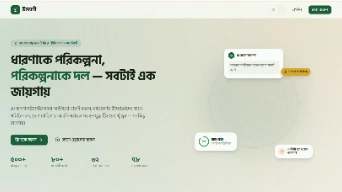
Most Bangladeshi founders today start the same way: a WhatsApp voice note to a friend, a few hours arguing about the idea over cha, and then — if they're online-savvy — a conversation with ChatGPT that gets copy-pasted into a Google Doc nobody opens again. None of that structure survives past the first week, and none of it helps the founder find a co-founder or an early teammate. Uddogi exists to fix that specific gap: not "another AI chatbot," and not "another job board," but the connective tissue between the two — a place where validating an idea and finding the person to build it with are the same product, not two separate tabs.
The platform has three moving parts that share one underlying data model. An AI startup consultant, built on Google's Gemini, interviews the founder — either helping them discover an idea from their skills and interests, or pressure-testing one they already have — and turns that conversation into a structured, versioned thesis covering the problem, market, feasibility, MVP roadmap, financial shape, and the skills the venture actually needs. Once a founder confirms that thesis, it becomes the basis for teammate matching: candidates whose profile skills overlap with what the venture needs are ranked by a transparent, deterministic score — never an AI's opinion — and the founder can send a request, which the candidate accepts or declines from their own inbox.
Everything in that paragraph is built and running today, not conceptual. The AI conversation streams live over the wire, the thesis is real structured JSON stored and versioned in Postgres, and the match score is a formula anyone can read straight out of the source code.
Early founders don't lack ideas — they lack structure, and they lack teammates. Three specific frictions repeat across nearly every first-time founder's early weeks, and none of the tools currently available to a Bangladeshi founder solve more than one of them at a time.
The validation tools are generic, English-first, and forget everything. General-purpose AI chat products are extraordinary at reasoning, but they were not built to hold a founder's hand through a repeatable, structured process. A founder opens ChatGPT, describes an idea in whatever English they can manage (a real barrier for a huge share of first-time founders whose first language is Bangla), gets a burst of decent advice, and then the session ends. Nothing is saved as a plan. Nothing is versioned. There is no "confirm this thesis" moment, no record of what was decided last week versus what changed this week, and certainly no bridge from "I validated this idea" to "now show me someone who can build the frontend."
Team formation runs entirely on personal network and luck. Ask any founder in Dhaka how they found their first technical co-founder, and the honest answer is almost always some version of "a friend of a friend." That works for the well-connected minority and fails everyone else — including exactly the skilled, motivated seekers who would make excellent teammates but simply aren't in the right WhatsApp group. Existing job boards and freelance marketplaces are built around paid work, not around the specific, high-trust ask of "join my unproven idea as a teammate," and they carry none of the context a matching decision actually needs: what does this founder's venture require, and does this candidate's real skill set — not their resume keywords — actually fit?
Where matching does exist, it's a black box. Where matching algorithms do exist on other platforms, they are frequently opaque — a ranked list with no visible reasoning, produced by a model the user can't interrogate. For something as consequential as "who do I bring onto my startup," a black-box score is close to useless; a founder needs to see why a candidate ranked where they did, and a candidate deserves to understand what's being measured about them.
Layer these three frictions together and the actual cost becomes clear: promising ideas stall at the validation stage because there's no structured way to work through them, and promising ideas that do get validated stall again at the team-formation stage because there's no trustworthy way to find the second or third person. Uddogi is built to remove both stalls at once, in one language-appropriate, connected workspace.
Uddogi's core insight is architectural as much as it is a feature list: the AI conversation, the structured plan, and the teammate search should never be three separate products stitched together after the fact. They should share one identity, one data model, and one continuous flow, so that finishing step one automatically sets up step two.
The flow: Consultant → Workspace → Matching. A Bangla AI conversation produces a structured thesis; the thesis is drafted, reviewed, confirmed, and versioned in a workspace; and a confirmed thesis feeds directly into candidate search and team requests.
Practically, this means a founder never re-types their idea for a "listing" the way they would on a separate job board — the listing is the confirmed thesis, automatically. It means a candidate's skills, once entered as a free-text tag during onboarding, are immediately searchable by any founder whose venture needs that exact skill, with no separate "apply" step required on the candidate's side. And it means the whole experience, from the very first AI message to accepting a team request, happens in Bangla, in one visual language, without the founder ever needing to translate their thinking into English to get useful output.
Registration and profile. Registration is a short multi-step form: account credentials, a public identity (name, short bio, and whether the person is a founder, a seeker, or — very commonly — both), a field and availability, a location with a privacy precision the user controls (exact address, city-level, or region-level only), and finally skills and interests. Crucially, skills and interests are typed freely as tags, not chosen from a fixed dropdown — a founder or seeker enters exactly what they know how to do, in their own words, and the system reconciles it against a shared taxonomy in the background so matching still works at scale without ever forcing a user into a category that doesn't quite fit.
Choosing a mode: ideation or validation. Starting a consultant session means picking one of two modes. Ideation mode is for the founder who knows they want to build something but doesn't yet know what — the consultant asks about their background, skills, interests, available resources, and appetite for risk, and works toward a concrete idea from there. Validation mode is for the founder who already has an idea and wants it stress-tested: the consultant interviews them specifically about that idea's problem, audience, and feasibility.
The conversation itself. Either way, the conversation runs as a real-time streaming chat — replies appear token by token rather than as one long pause followed by a wall of text, and while the consultant is composing the full structured analysis, the interface shows short live status lines (things like "বাজার বিশ্লেষণ তৈরি করছি..." — "preparing market analysis...") so the founder always knows the system is actively working rather than stuck. The consultant asks roughly four to five grounding questions — the core problem, the proposed solution, the target customer, the founder's relevant skills and resources, and their rough sense of the competitive landscape — then offers a short summary and a clear, explicit action to proceed to the full analysis. Nothing about that question sequence is hardcoded in the application; it is entirely the AI's own judgment, guided by a system prompt.
From summary to full thesis. Once the founder confirms they're ready, the consultant asks one or two clarifying follow-ups if needed, then generates the complete structured thesis — market analysis, feasibility rating, financial shape, MVP roadmap, required resources, and required skillsets — as a single structured object, not prose the founder has to parse by hand. That thesis appears immediately in the founder's workspace as a draft, versioned from the moment it's created.
Confirming and publishing. A draft thesis is private and can be regenerated as many times as the founder wants — asking the consultant to revise it, adding new information, or simply starting over. Confirming a thesis is a distinct, deliberate action, available both as a button in the workspace and as a natural-language instruction inside the chat itself (the founder can simply tell the consultant "confirm this thesis" and it will). The moment a thesis is confirmed, it becomes visible as a listing in teammate matching — there is no separate publishing step, no extra form to fill out; the validated plan the founder just built is the listing.
Finding and requesting teammates. From a confirmed listing, the founder sees the required skillsets the AI identified, each tagged with a priority. Expanding any one of them runs a live candidate search — every seeker whose profile skills overlap with that specific tag, ranked by the deterministic match score, with the score's components shown, not hidden. The founder can open any candidate's profile, see their availability, location (respecting whatever privacy precision that candidate chose), and current projects, then send a team request tied to that specific skill.
Responding and collaborating. The candidate sees incoming requests in their own inbox and accepts or declines each one. An accepted request immediately shows up as a current, active project on both sides — the founder sees a new collaborator attached to their venture, and the candidate sees the project on their own "current work" page.
Six areas make up the product surface, each built and functioning today:
The eight sections of a thesis. The structured plan the consultant produces is deliberately shaped like something a founder could actually hand to a mentor or an early collaborator, not a generic AI essay: (1) idea summary — problem, solution, target customer, value proposition; (2) feasibility assessment — a rating with reasoning, not just a label; (3) market analysis — market description, target segment, named competitors, and real differentiation; (4) licensing/legal notes — clearly informational only; (5) MVP roadmap — phased, with estimated timeframes; (6) financial evaluation — cost categories, revenue model, runway notes, informational only; (7) required resources; and (8) required skillsets — tagged and prioritized, the exact list matching runs against.
Reliability, not just capability. A less obvious but important part of the build is what happens when the AI doesn't behave perfectly — because large language models, however capable, don't reliably call the right function at the right moment every single time. Rather than leaving a founder stuck staring at a chat that silently stalled, the backend carries deliberate safety nets: if the consultant's reply reads like a wrap-up rather than another question but it forgot to trigger the "ready to proceed" action itself, the interface offers that action anyway once enough of the conversation has genuinely happened. And every call to the AI provider is wrapped in a bounded timeout, so a stalled network connection produces a clear, recoverable error message instead of an indefinitely frozen chat.
It would have been easy to hand candidate ranking to the same AI model doing everything else in the product. Uddogi deliberately does not do this. Deciding who a founder should trust with their early-stage venture is exactly the kind of high-stakes, high-consequence decision that needs to be explainable in plain terms, not delegated to a model whose reasoning can't be fully inspected or guaranteed to repeat. So match scoring runs on a fixed, auditable formula instead:
Every candidate a founder sees in a search comes with that breakdown visible, not just a single opaque total. A candidate who scores highly for skill overlap but lives far from the founder can see exactly why their total isn't higher; a founder can see exactly why one candidate outranked another. The rule the product is built around: an AI should help a founder think, but it should never be the reason a human being does or doesn't get a chance to join a team.
The technical choices behind Uddogi follow the same philosophy as the product decisions: keep the parts that need to be trustworthy simple and inspectable, and reserve the AI for the one job it's genuinely good at.
Frontend — React 19 and TypeScript, built with Vite, styled with Tailwind CSS and DaisyUI, animated with Framer Motion. Routing is a small hash-based system rather than a heavyweight router library. Hind Siliguri, a typeface designed for comfortable Bangla-and-Latin text side by side, is used throughout.
Backend — Node.js and TypeScript on Fastify, talking to PostgreSQL through the pg driver with hand-written, sequential, idempotent SQL migrations rather than an ORM. Authentication uses opaque, hashed session tokens rather than JWTs, with email lookups performed through an HMAC index. The Gemini API key, and every other secret, lives only on the server.
The AI layer specifically — The consultant's entire behavior is driven by a system prompt given to Gemini, not by decision-tree code in the application. Application code handles transport, persistence, validation, and the reliability safety nets described earlier, but it never hardcodes what the AI should say.
Deployment — The frontend and backend deploy as two independent services, connected by a simple path rewrite rather than any tight coupling.
Bangladesh has a young, large, increasingly online population and a visibly growing appetite for entrepreneurship — from small e-commerce sellers building a business through Facebook and mobile payments, to university students forming their first startup teams. What's consistently missing from that energy is founder-facing tooling built for that context rather than translated into it after the fact. Nearly every serious startup-planning tool, AI product, or team-matching platform available today assumes English fluency, assumes a founder already has the vocabulary of venture-building, and assumes access to the kind of informal advisor network that concentrates in a handful of well-connected circles.
That gap is exactly where Uddogi sits. A Bangla-first interface removes a real barrier for founders whose first and most comfortable language isn't English, without dumbing down the actual substance of what the tool produces. And because matching is built into the same platform rather than a separate product, a founder doesn't need an existing network to find their first collaborator — the tool itself becomes the network.
Three things distinguish Uddogi from the nearest adjacent categories of product, and all three are structural, not cosmetic:
The current build covers the full loop from idea to validated plan to a connected teammate — that loop works end to end today. The most immediate next steps extend depth within that same loop: turning the current accept/decline request inbox into a full private message thread once two people are working together, expanding the shared skill and interest taxonomy as real usage reveals gaps, and adding lightweight signals — like how quickly a founder responds, or a track record across past accepted projects — into the visible match breakdown, always as an additional transparent component rather than a hidden AI judgment.
Longer term, the same architecture that makes one founder's confirmed thesis instantly searchable by candidates scales naturally toward richer discovery — browsing and filtering listings directly, not only searching per-skill from inside a founder's own venture — and toward supporting founders and seekers across more of the wider South Asian startup landscape without changing the underlying product philosophy: structured over unstructured, transparent over opaque, and native to the language people actually think and build in.
Uddogi is what happens when validating a startup idea and finding the person to build it with stop being two separate problems — one connected, Bangla-first workspace where an AI consultant turns a conversation into a real plan, and a transparent, deterministic matching engine turns that plan into a team.
Note on scope: sections 4 through 7 reflect the platform as it is actually implemented and running today — the consultant, the eight-section thesis, the scoring formula, and the request inbox are live, not conceptual. Section 10 is explicitly forward-looking.
Loading comments...
How the community currently views this idea
Loading...
